Regular vs “Deep” Dental Cleanings — What’s Really Happening Underneath Your Gums
All Cleanings Aren’t The Same
Most of us understand the difference between a "regular clean" and a "deep clean" for a house. One is about maintenance — the routine tasks that keep everyday dirt at bay. The other is a far more extensive effort, tackling the hidden grime and buildup in often-neglected spots. It's the difference between a weekly wipe-down and a full spring cleaning.
This same concept exists in dentistry, where clinicians talk about "regular" and "deep" cleanings. While the terms are similar, the science behind them is far more surprising, and the stakes for your dental and overall health are infinitely higher. What’s really happening below your gumline is a microscopic battle with complexities most patients never imagine. This article will pull back the curtain on the dental cleaning, revealing four of the most counter-intuitive and impactful truths from the world of periodontal science. It’s time to dive deep and understand what your dental cleaning truly means and does.
That Tartar On Your Teeth? It's a Living Bacterial Metropolis.
The common belief is that tartar, or what dentists call calculus, is just fossilized plaque — a hard, dead, mineralized stain that needs to be scraped away. Advanced microscopy, however, tells a much more nuanced story. According to research in the Journal of Periodontology , subgingival (below the gumline) calculus is not an inert substance. It is a porous structure comprised of 20%-25% organic material, including communities of live, viable bacteria living within its internal channels and lacunae — think of a hardened sponge with tiny organisms embedded in all it’s holes and crevices… This means the tartar attached to your roots is a bustling, metabolically active metropolis of microbes. Because it serves as a persistent source of irritation, continuously promoting inflammation, researchers Irwin Mandel and Abdol-reza Gaffar powerfully described its function as a “slow releasing device”. This completely changes the perception of tartar. It’s not just a cosmetic issue or a hardened remnant of past neglect; it is an active, harmful colony that must be thoroughly destroyed to allow your gums to heal. Removing it isn't just cleaning — it's the systematic dismantling of a living, hostile fortress.
Bacteria Don't Just Sit on Your Teeth—They Can Invade Them.
Removing the biofilm and calculus from the surface of your tooth’s root is only part of the battle. The shocking truth is that the problem isn't just on the tooth; it can also be in the tooth. Multiple studies have demonstrated that pathogenic bacteria can actually invade the root structure itself, penetrating the outer layers of cementum and the underlying dentin. Researchers like P.A. Adriaens and G. Giuliana have identified periodontal pathogens, such as the notorious Porphyromonas gingivalis, deep inside the radicular dentin (the outer layer of the tooth’s roots) of periodontally diseased teeth. These invasive bacteria establish a "reservoir" from which the periodontal pocket can be re-colonized, contributing to reinfection even after a seemingly successful cleaning — just because it feels smooth and clean, doesn’t mean it is clean enough to allow your gums to become healthy again. This hidden enemy can often be harbored in microscopic irregularities on the root surface, such as resorption defects (lacunae) and microfractures, which offer perfect shelter and make them incredibly difficult to remove with instruments. This discovery fundamentally changes the battlefield. The fight isn't just on the outside of the tooth; it's a microscopic siege to root out an enemy that has already breached the fortress walls (no pun intended).
A "Perfect" Deep Cleaning is Almost Impossible to Achieve.
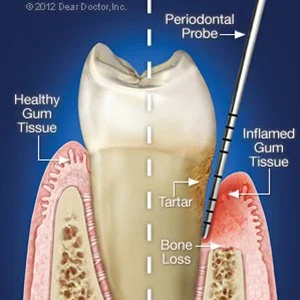
Scaling and Root Planing (SRP) is the cornerstone of non-surgical periodontal therapy and is remarkably effective at reducing inflammation and pocket depths. However, the counter-intuitive reality is that achieving complete removal of all subgingival calculus and biofilm in a single go is exceptionally rare. SRP is a technically demanding procedure, and its effectiveness is limited by several challenging factors. Studies have shown that the success of calculus removal drops dramatically as the periodontal pocket gets deeper. One study noted that in pockets deeper than 5mm, clinicians achieved complete calculus removal only 11% of the time. Factors that reduce the effectiveness of SRP include:
Increasing pocket probing depth: The deeper the instrument has to go, the harder it is to be effective.
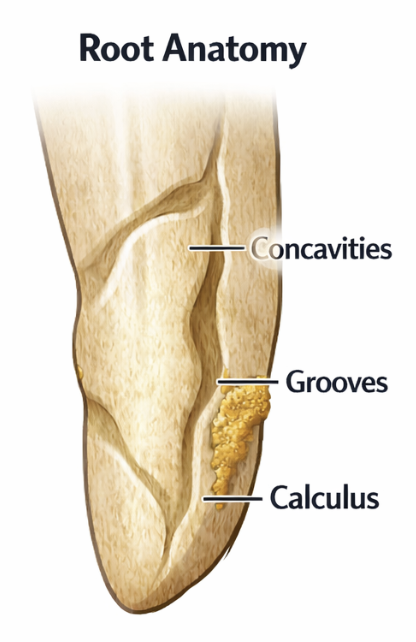
Root anatomy: Concavities, grooves, and other anatomical irregularities on the root surface provide hiding places for deposits.
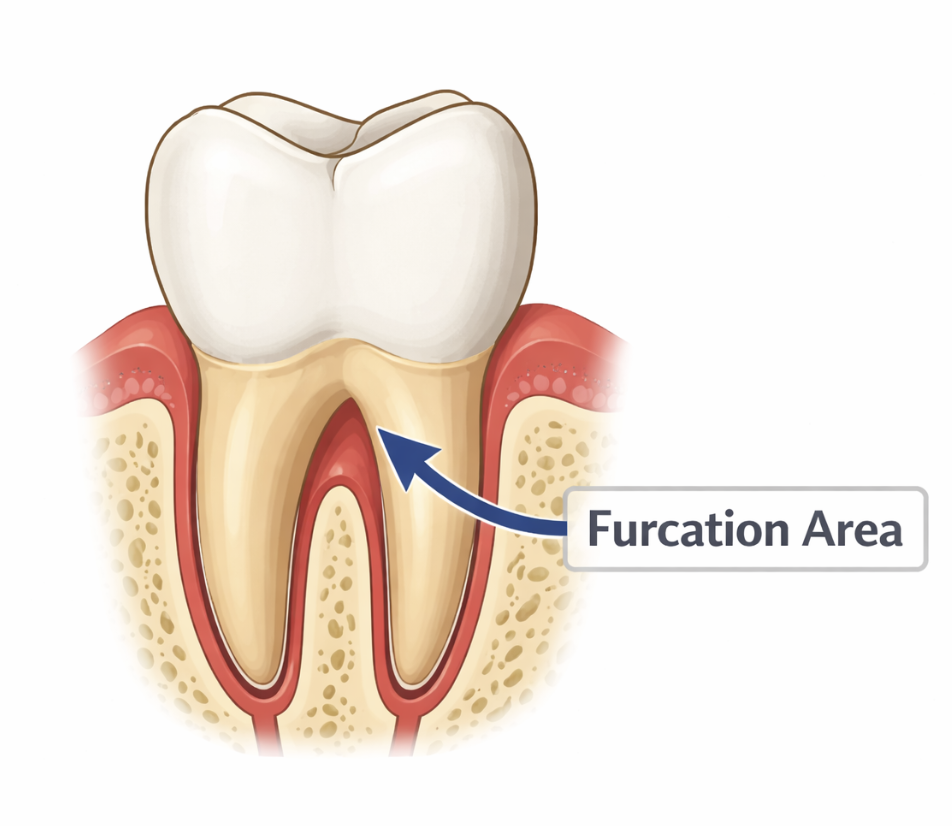
Furcation involvement: The area where the roots of multi-rooted teeth divide is notoriously difficult to clean.
Clinician factors: The skill, time spent, and experience of the clinician play a significant role. Paradoxically, one of the most common sites for residual calculus after SRP is the cemento-enamel junction (CEJ)—the area where the crown meets the root. Despite being a relatively accessible site, its unique anatomy often traps deposits. This reality underscores a critical point for patients: a deep cleaning is often the beginning, not the end, of treatment. This is why periodontal maintenance isn't just a "check-up"; it's the strategic, ongoing management required to control a chronic infection that can never be completely eradicated in a single battle.
For Healthy Gums, Aggressive Cleaning Can Actually Cause Harm.
In health, we often assume that more is better. A more thorough cleaning must be a good thing, right? When it comes to periodontal treatment, the answer is surprisingly, not always. Periodontal science has identified a concept known as the "critical probing depth." In simple terms, this is the specific pocket depth at which a given therapy switches from being beneficial (causing the gums to gain attachment to the tooth) to being potentially harmful (causing them to lose attachment).For scaling and root planing, the critical probing depth has been identified as 2.9 mm. This means that performing SRP in shallow, healthy pockets — those measuring 1-3 mm — can actually lead to a slight, measurable loss of gum attachment. This happens because the instrumentation, which is designed to remove diseased tissue and deposits, can disrupt the healthy connection between the gum and the tooth in an area that doesn't need it.This is a crucial takeaway. It highlights that periodontal treatment is not a one-size-fits-all procedure. It must be precise and targeted only to diseased sites. This is the fundamental scientific principle that separates a preventative "regular cleaning" (a prophylaxis) for healthy tissue from a therapeutic "deep cleaning" for areas already experiencing periodontal disease.
Conclusion: A Deeper Respect for Your Dental Health
The landscape below your gumline is far from static. It is a dynamic environment of living bacterial strongholds, hidden reservoirs, and microscopic challenges that push clinical skill to its limits. Understanding this complex reality transforms the dental cleaning from a routine polish into what it truly is: a precise, scientific intervention essential for your overall health. The next time you sit in the dentist's chair, you'll know the real fight is happening far beyond what you can see, and you'll have a much deeper respect for the science dedicated to winning it.
Questions To Ask If Your Told You Need A Deep Cleaning:
“What are my probing depths?” The only way to know this is my doing a complete periodonal exam, where your dentist or hygienist will probe at 6 distinct points around each tooth. This feels like a minor prick (not the most comfortable thing ever). If they didn’t do this exam, there is no way to know what your probing depths are. Furthermore, if they don’t establish this baseline and record it in your dental records, there is no way to know if your gum health is improving at subsequent follow-up appointments.
“When will my next appointment be?” A true, thorough Scaling & Root Planing (SRP) therapy requires a follow-up appointment 4-6 weeks after the initial therapy. At this appointment, your provider should be re-probing. If you still have areas with significant inflammation, bleeding, or pus, further treatment is needed.
“Will I need another deep cleaning in the future?” The goal of the deep cleaning therapy (SRP) is to reduce your periodontal pockets — those probing depths we’ve mentioned. If the therapy is successful, your pocket depths should reduce and you should be able to re-establish healthy gums and bone (the periodontium structure). If you’re told every time you come in for your check-up that you need a deep cleaning, chances are you need a different type of intervention — maybe via surgery, antibiotic treatments, etc. You may need to be referred to a periodontal specialist in cases where your general dentist’s office can not manage the disease.
Sources:
Cobb CM, Sottosanti JS. A re-evaluation of scaling and root planing. Journal of Periodontology. 2021;92(10):1370–1378.
A-re‐evaluation-of-scaling-and-…Mensi M, Sordillo A, Marchetti S, et al. Clinical comparison of guided biofilm therapy and scaling and root planing in the active phase of periodontitis management. European Journal of Dentistry. 2025;19(2):482–492.
Guided biofilm therapy vs SRPSmiley CJ, Tracy SL, Abt E, et al. Systematic review and meta-analysis on the nonsurgical treatment of chronic periodontitis by means of scaling and root planing with or without adjuncts. Journal of the American Dental Association. 2015;146(7):508–524.
Non surgical perio tx via SRPDeas DE, Moritz AJ, Sagun RS Jr, et al. Scaling and root planing vs conservative surgery in the treatment of chronic periodontitis. Periodontology 2000. 2016;71:128–139.
SRP-vs-Surgery-Deas_et_al-2016-…Mailoa J, Lin GH, Khoshkam V, et al. Long-term effect of four surgical periodontal therapies and one non-surgical therapy: A systematic review and meta-analysis. Journal of Periodontology. 2015;86(10):1150–1158.
Surgical vs non surgicalGolden State Dentistry. Regular dental cleaning vs deep cleaning: What is the difference?
https://www.goldenstatedentistry.com/blog/regular-dental-cleaning-vs-deep-cleaning-what-is-the-differenceSensational Smiles. Deep cleaning (scaling and root planing).
https://sensationalsmiles4u.com/blog/general-dentistry/deep-cleaning/Healthy Smiles of Virginia. Deep cleaning vs regular cleaning.
https://www.healthysmilesva.com/deep-cleaning-vs-regular-cleaning/ProGrin Dental. Deep cleaning vs regular cleaning: What’s the difference?
https://progrin.com/blog/deep-cleaning-vs-regular-cleaning/